
In March 2026, we were delighted to be collaborating with Gareth Metcalfe for two special events: a webinar for teachers followed by an exclusive live lesson for your class.
📅 Teacher Webinar: 11th March 2026
📅 Live Lesson for Classes: 26th March 2026
The webinar explored key ideas and practical strategies that were classroom-ready, and the live lesson gave students the opportunity to experience those ideas in action.
If you missed them, don’t worry! You can watch back the recordings by heading to On Demand in your Online Training area.
In addition to the webinar and live lesson, Gareth penned a blog exclusively for TT Rock Stars. So let’s pass the mic to Gareth Metcalfe, Director of I See Maths.
We want children to have opportunities to be playful in mathematics. We want them to experiment, persevere through challenge, search different possibilities and spot patterns. This is the true nature of what it means to be a mathematician.
Here, we look at opportunities for open-ended mathematical exploration in multiplication to engage all children in extended problem-solving. This article looks at different ways the same ‘big mathematical idea’ can be explored. We will consider how we can gradually sequence tasks so that all children can be supported and all children can be challenged. Expect some thought-provoking, exciting lessons!
The Sum and the product
Before this task, we must ensure that children understand the terms ‘sum’ and ‘product’. This can be done by giving an example: ‘The sum of 6 and 2 is 8 (6+2=8). The product of 6 and 2 is 12 (6×2=12).’
Then, we must check for understanding before the children engage in the main task. For example, ‘What is the sum of 5 and 3? What is the product of 5 and 3?’. When children are secure with this terminology, we are ready to progress.
Next, we can give children these calculations and ask them what they notice:
5 + 5 =
6 + 4 =
7 + 3 =
8 + 2 =
Of course, the sum of each pair of numbers is the same. When one addend increases by 1 and the other addend decreases by 1, the sum of the pair of numbers stays the same.
Then, children consider these calculations. What do they notice this time?
5 × 5 =
6 × 4 =
7 × 3 =
8 × 2 =
Now, the products are not the same. When a pair of factors increases/decreases by 1, the product becomes smaller! Is this always true? The children could create some of their own example questions to test this theory. Or we could ask them to predict which calculation will have the larger product: 6 × 6 or 7 × 5?
Then, a more open challenge can be introduced. Usually, I would introduce the task in stages so it’s not too overwhelming when the task is first presented.
Step 1
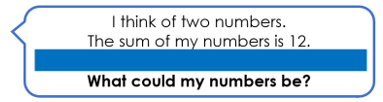
Step 2
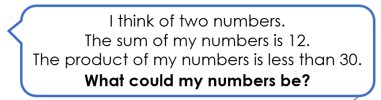
Can children find an answer? A different answer? Or maybe even work systematically to find all the possible answers, like this:
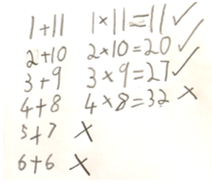
New follow-up questions can be created, for example by changing the word in the question from ‘less’ to ‘more’.
The same ‘big idea’ can be explored with older children, working in a larger number range. For example, when we look at this sequence of questions, the same pattern is revealed:
10 × 10 = 100
11 × 9 = 99
12 × 8 = 96
13 × 7 = 91
14 × 6 = 84
However, another thing can be drawn out. Consider how much smaller than 100 each of the products is:
10 × 10 = 100
11 × 9 = 99 (1 less)
12 × 8 = 96 (4 less)
13 × 7 = 91 (9 less)
14 × 6 = 84 (16 less)
This reveals an amazing pattern: the products are decreasing in a pattern of square numbers! Does this work just for this example sequence? Or could it also be true for other sequences? Investigate…
AREA AND PERIMETER
Here is one of the requirements from the Year 6 National Curriculum: Recognise that shapes with the same areas can have different perimeters and vice versa. In this statement, we are asking children to explore the exact same mathematical idea! For example, children can be asked to calculate the perimeter and area of these two rectangles:
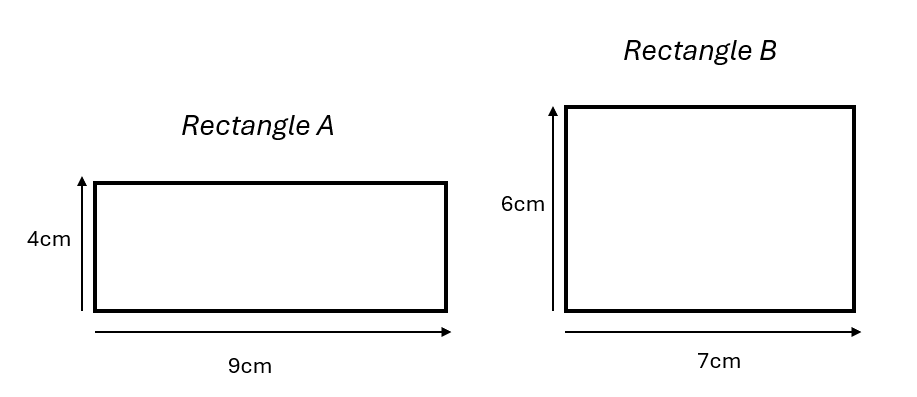
Whilst the rectangles have the same perimeter, they don’t have the same area. Rectangle B has side lengths that are closer together in value, therefore it has a larger area. Then, children could create their own example rectangles to test this theory further.
The Largest Product
There is another way in which we can explore the same big mathematical idea. Consider this task:
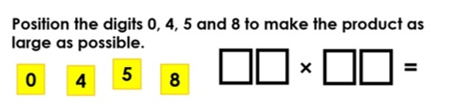
To begin with, children can explore different possible combinations of multiplication calculations. Then, we will emphasise the first level of reasoning: to maximise the product, we must place our largest digits in the most significant columns. Put the digits 8 and 5 in the tens positions.
Then, does it matter which way around we position the digits 4 and 0? Yes! The product is maximised when the numbers being multiplied are as close together as possible. 80 × 54 has a larger product than 84 × 50. Why is this? The picture below demonstrates:
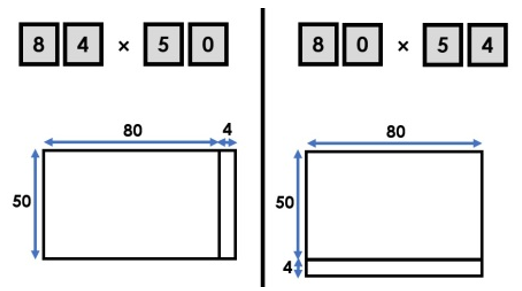
Both calculations include 80 × 50. For 84 × 50, we have 4 more lots of 50. For 84 × 50, we have 4 more lots of 80. This gives us a larger product.
In exploring this big mathematical idea in any of these ways, children will be practicing their calculation skills in multiplication. But they will get so much more from engaging in these tasks. They will have to spot patterns, test new ideas with their own questions and try different ways. Children will have a context in which to explain their thinking clearly, giving relevant examples and explaining what they have found. They will be stretched personally as well as mathematically. It will enable children to experience what it means to be a true mathematician!